Kvint-6 Architecture
The Kvint-6 hardware and software system consists of four subsystems:
Remikonts perform data acquisition and preliminary processing, automatic control, discrete and logical sequential control, process protections and interlocks, event logging, and control of actuators. Kvint-6 includes two types of controllers: the multi-purpose, multichannel Remikont R-380 and the compact field Remikont R-390. Each controller operates independently of other devices but can exchange information with other controllers and with upper-level equipment.
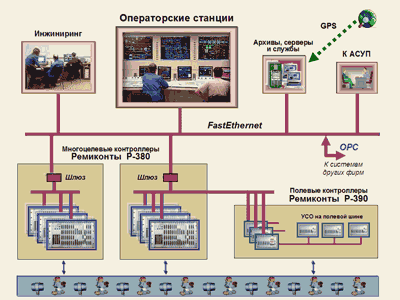
Large-scale system architecture
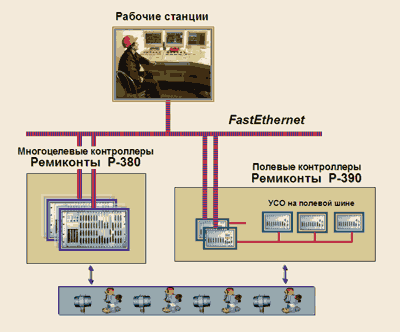
Small- and medium-scale system architecture
Workstations provide information display, archiving and analysis. They also perform statistical and optimization calculations and monitor the condition of all Kvint-6 hardware and software components operating within the automated process control system.
Networks provide information exchange among Kvint subsystems and between Kvint and enterprise departments, such as planning and accounting. All controllers and workstations are connected to an Ethernet network. Remote I/O units of field controllers are connected to the central unit via a fieldbus. Large systems are divided into individual system modules that combine separate groups of controllers. Each group is connected to the upper-level network through a gateway. In small systems, all controllers and workstations are connected to one shared Ethernet network.
Computer-aided design tools provide a set of powerful tools for designing automated process control systems: creating the project database, administration, preparing video displays and controller process programs, and designing calculation tasks.
A dedicated Kvint-6 service synchronizes all events to a common time source, either local or astronomical time received via the GPS satellite channel.
Any third-party technical equipment that supports OPC technology can be integrated into Kvint.